You have achieved that pearly white and flawless “Hollywood smile” you’ve always dreamed of, or perhaps you are considering getting it done. However, there is a nagging question in your mind: “Will these veneers cause bad breath over time?”
This is one of the most frequently asked and most misunderstood topics in cosmetic dentistry. The short answer: No, a high-quality dental veneer itself does not cause odor. However, the long answer is a bit more complex and is entirely related to biology, hygiene, and craftsmanship.
In this article, we examine in detail why veneers are sometimes associated with odor, the real reasons lying beneath this issue, and how you can keep your breath fresh.
Myth vs. Reality: Does the Veneer Material Smell?
First, let’s clarify this distinction: Modern veneer materials used today (Porcelain, Zirconia, E-max) are non-porous, have a glassy surface, and do not absorb liquids.
Important Note: High-quality dental porcelain or zirconia does not naturally retain or emit odors. If there is a smell, it originates not from the veneer material itself, but from what is happening around it.
However, some acrylic or composite temporary veneers used in the past could absorb liquid over time and cause odor. If you are experiencing odor with your permanent veneers, the culprit is not the material, but the “bacteria.”
Why Do Veneers Cause Bad Breath? (The Hidden Culprits)
If you are experiencing bad breath (Halitosis) even though you have permanent and high-quality veneers, the source of the problem is usually one of the following four factors:
1. Poor Edge Fit (Marginal Leakage)
This is the most technical and most common cause. The point where the veneer meets the gum line must be flawless. If a microscopic gap or “ledge” remains between the veneer and your natural tooth:
- Food particles get trapped in this gap.
- Your toothbrush cannot reach there.
- Bacteria multiply here, leading to decay and a sulfur-based foul odor.
2. Gum Diseases (Gingivitis)
Sometimes, veneers may be designed in a way that puts too much pressure on the gums or they may be placed too deeply. This situation irritates the gums, leading to swelling and bleeding. Inflamed gums and drying blood emit a very characteristic and unpleasant odor.
3. Inadequate Oral Hygiene
“My teeth are veneered now, they won’t rot, so I don’t need to brush as much as before” is, unfortunately, a wrong mindset. Your natural tooth underneath the veneer can still decay. Especially when dental floss is not used, plaque accumulating between two veneers calcifies and turns into an odor bomb.
4. Cracked or Broken Veneers
If there is a tiny crack in your veneer that is hard to see with the naked eye, bacteria can leak in and settle inside this crack. This becomes a sheltered nest for them and becomes impossible to clean.
Which Types of Veneers Cause Less Bad Breath?
Zirconia Veneers
- Smooth surface
- High compatibility with gums
- Low bacterial retention
It is one of the veneer types with the lowest risk of bad breath.
Porcelain Laminates (Laminate Veneers)
- Very thin and natural
- Excellent gum compatibility
- Aesthetic and hygienic
When applied correctly, they do not cause bad breath.
Metal-Fused-to-Porcelain Veneers
- Darkening at the gum line over time
- Gum compatibility issues
- Higher risk of odor
Solutions: What Should You Do?
If you have an odor that you think is caused by your veneers, do not panic. Here is your step-by-step solution map:
Step 1: Switch to a “Super Hygiene” Routine
You must go beyond normal brushing. Veneers can change the contact points between teeth.
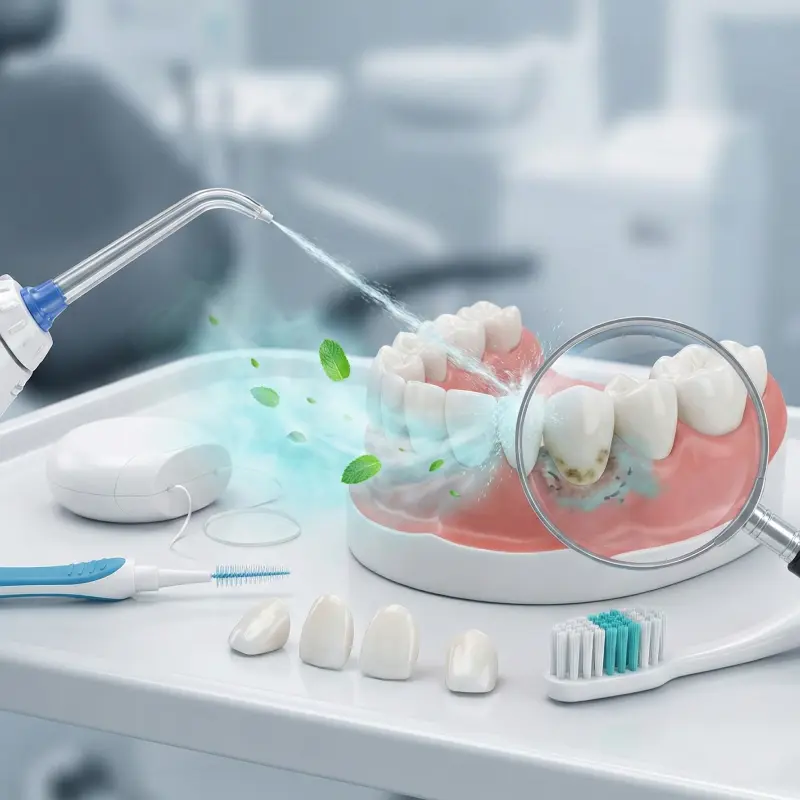
- Use a Water Flosser: This is a must-have for veneer users. Pressurized water cleans the pockets between the veneer and the gum line that brushes and floss cannot reach.
- Dental Floss (Superfloss): If you have bridges or connected veneers, use dental floss with special tips to clean underneath them.
Step 2: Visit Your Dentist
The odor might be a “fit issue” that cannot be solved at home. Your dentist will check the following:
- Is there a gap at the edge of the veneer?
- Is there decay under the veneer? (Check with X-ray)
- Is there any residual adhesive (cement)?
Step 3: Replacement if Necessary
If your veneers are putting pressure on your gums (violating biological width) or if the edge fit is compromised, the smell may not go away no matter how much you brush. In this case, replacing the veneers in a way that respects gum health is the only definitive solution.
Summary Table: Source of Odor and Solution
| Problem | Symptom | Solution |
| Inadequate Hygiene | General bad breath, plaque accumulation. | Water flosser, interdental brush, regular brushing. |
| Gum Inflammation | Bleeding while brushing, red gums. | Tartar cleaning (scaling) and mouthwash use. |
| Ill-fitting Veneer | Localized smell around a specific tooth. | Replacement of the veneer by the dentist. |
| Old Veneers | Aged, matte, or cracked surface. | Aesthetic and functional renewal. |
Conclusion: A Beautiful Smile is Possible with Fresh Breath
Remember, a well-made veneer does not cause bad breath. Bad breath is a signal that something is going wrong (bacterial accumulation, incompatibility, or disease).
Your veneers are not everlasting, but when well-maintained, they can be used problem-free for 10-15 years. If you are fighting a constant smell, do not accept this as the “nature of the veneer.” Consult a dentist to identify the source of the problem and regain that fresh breath you miss.
Frequently Asked Questions
Do dental veneers cause bad breath?
No. Dental veneers that are correctly made and well-maintained do not cause bad breath. Bad breath usually stems from veneer incompatibility or inadequate oral care.
Why does bad breath occur after getting dental veneers?
The most common causes are; the veneer not fitting the tooth perfectly, gum inflammation, decay forming under the veneer, and failure to use dental floss.
Is bad breath normal after getting veneers?
No. Persistent bad breath after veneers is not normal and must definitely be evaluated by a dentist.
Do Zirconia veneers cause bad breath?
No. Thanks to their smooth surface and gum compatibility, Zirconia veneers are one of the veneer types with the lowest risk of bad breath.
Do porcelain laminates cause bad breath?
When applied correctly, no. Since laminate veneers are very thin, they are hygienic and have high compatibility with gums.