This content has been prepared and reviewed by Omer Istanbul dentists in light of current clinical practices and scientific literature. The information in the article is for general informational purposes; your suitability for implant treatment is clarified only through examination and tomography (CBCT) evaluation.
One of the most frequently heard sentences in the dentist’s chair is: “Your bone is insufficient, we cannot place implants.”
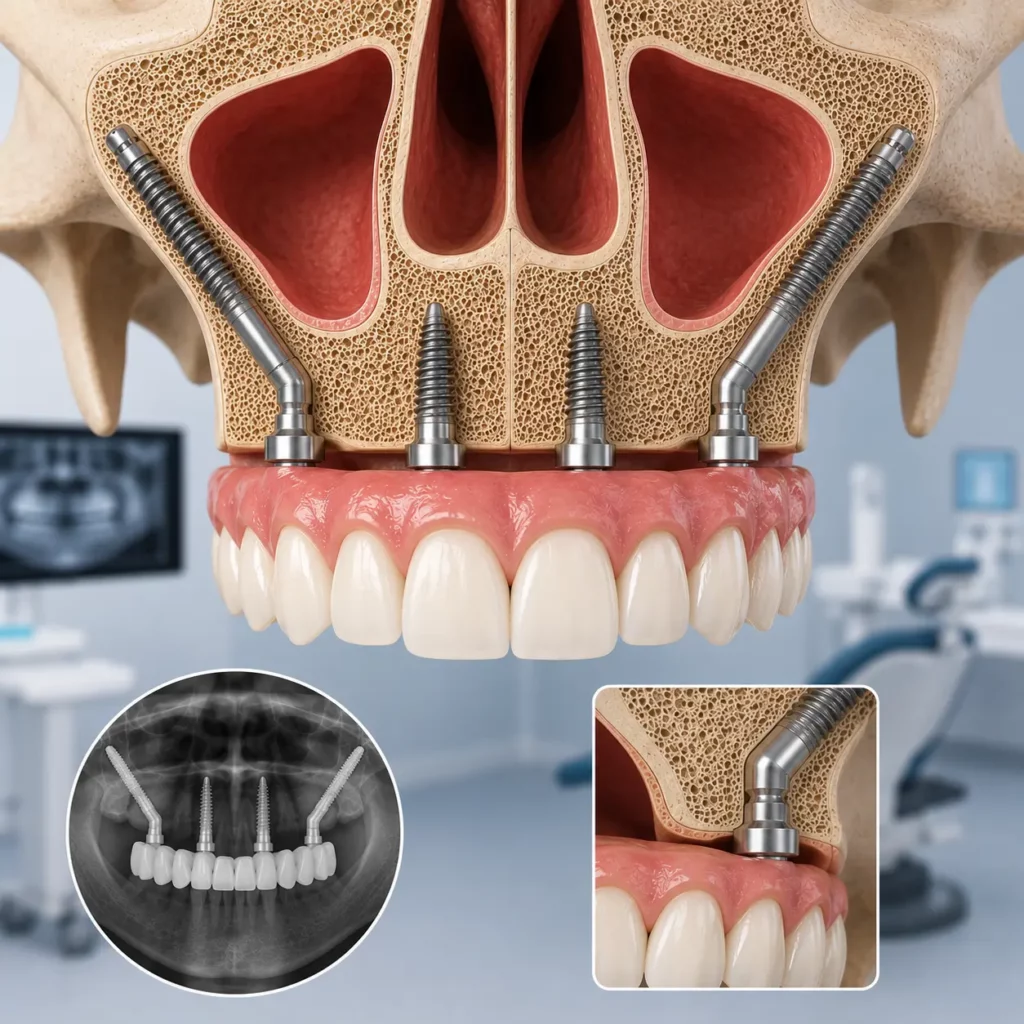
Years ago, this sentence was indeed the end of the road. Not today. The zygomatic implant technique, developed especially for patients experiencing severe bone loss, has largely left this sentence in the past. Allowing patients to have fixed teeth independent of the current bone condition—without the need for bone grafting or sinus lifting—this method is currently among the top-tier solutions evaluated for advanced cases.
In this article, we first cover why zygomatic implants stand out, who they are suitable for, and what can be expected throughout the process. Then, we briefly compare other methods evaluated for milder bone loss.
Zygomatic Implant: The First Choice in Advanced Bone Loss
Zygomatic implants, unlike standard implants, are anchored not into the jawbone, but into the zygomatic bone—commonly known as the cheekbone—which is anatomically much denser and more durable. Therefore, jawbone volume is no longer a decisive factor for implant stability.
Why Do Zygomatic Implants Stand Out?
- No bone graft or sinus lift required. In most cases, implants can be placed directly without the need for additional surgical procedures.
- The expectation of months-long healing disappears. Instead of waiting for the bone to fuse after a graft, a temporary fixed prosthesis can be applied on the same day in suitable cases.
- Practical for patients with limited travel time. Shorter treatment duration is a significant advantage, especially for international patients traveling on a tight schedule.
- A real solution for patients who have used removable dentures for years. Many patients who were previously told “your bone is insufficient” can now have fixed teeth thanks to zygomatic implants.
Who Are Zygomatic Implants Suitable For?
- Patients with severe bone loss in the upper jaw
- Patients with completely edentulous upper jaws who want fixed teeth
- Patients who have previously undergone bone grafting or sinus lifting without success
- Patients who do not want additional surgical procedures or wish to shorten treatment time
- Patients who are uncomfortable using removable dentures for many years
How Does the Process Work?
The decision for a zygomatic implant is finalized through a detailed examination of the jaw, sinus, and zygomatic region using 3D computed tomography (CBCT). At Omer Istanbul, this evaluation proceeds through the following steps:
- Online preliminary evaluation — an initial assessment is made based on existing X-rays or panoramic images.
- 3D imaging with CBCT — the density and suitability of the zygomatic bone for implants are measured.
- Consultation with the dentist — patient expectations and treatment timeline are clarified.
- Surgery and temporary fixed prosthesis on the same day in suitable cases — treatment duration is significantly reduced compared to standard graft procedures.
You can find more detailed information about this process in our zygomatic implant treatment article.
Other Methods Evaluated in Milder Bone Loss
Not every patient may be a candidate for a zygomatic implant — this method was specifically developed for advanced bone loss. For milder or moderate losses, the following options are also evaluated.
Standard Implant with Bone Grafting
Missing bone volume is supplemented with synthetic or natural bone material. Standard implants are placed after waiting for the graft to integrate with the bone. It is an effective method for moderate bone loss, but the healing process can take months and usually requires two separate surgeries.
Sinus Lifting
Applied when the sinus cavity in the posterior upper jaw expands. The sinus membrane is gently raised, and bone material is placed underneath. Similar to grafting, it may require a waiting period of 4–8 months prior to implant placement depending on the case.
Short and Narrow-Diameter Implants
These are alternatives that can be applied directly without additional surgery in mild-to-moderate cases with limited bone height or width.
All-on-4 / All-on-6
In fully teethless jaws, angled implants are placed in areas with the densest remaining bone to support a fixed prosthesis. Suitable for completely edentulous patients with moderate bone loss; however, in cases of severe bone resorption, even angled placement may not provide sufficient stability — this is where zygomatic implants come into play.
Comparison: Which Method is Suitable for Which Case?
| Bone Condition | Recommended Method | Is Additional Surgery Required? | Treatment Duration |
| Mild loss, narrow/short bone | Narrow-diameter / short implant | Usually no | Short |
| Moderate loss | Bone graft + standard implant | Yes | Long (months) |
| Posterior upper jaw, sinus-related loss | Sinus lifting | Yes | Long (4–8 months) |
| Fully teethless, moderate loss | All-on-4 / All-on-6 | Depends on the case | Moderate |
| Severe bone loss, fully teethless upper jaw | Zygomatic implant | Usually no | Short (same day in suitable cases) |
As seen in the table, especially in advanced cases, zygomatic implants stand out as the most practical option in terms of both surgical burden and duration.
Frequently Asked Questions
Does a zygomatic implant require a bone graft?
No, in most cases it is not required. Because the implant is anchored into the zygomatic bone instead of the jawbone, existing jawbone volume is no longer a deciding factor.
Can a zygomatic implant be applied to anyone?
No. This method was specifically developed for cases with severe bone loss in the upper jaw. For mild-to-moderate bone loss, other methods are usually sufficient. Suitability is confirmed via CBCT.
Can fixed teeth be attached on the same day after a zygomatic implant?
In suitable cases, yes. This is one of its biggest advantages compared to traditional grafting processes.
I was previously told “your bone is insufficient, we can’t do implants.” Do I still have a chance?
Most likely, yes. Zygomatic implants are a technique developed specifically for patients with this profile. A definitive answer is given after CBCT imaging and clinical examination.
Solution to Bone Loss
The phrase “your bone is insufficient” is no longer the end of the treatment journey, but rather the beginning of determining the right method. While options such as bone grafts, sinus lifting, short and narrow-diameter implants are evaluated for mild and moderate bone loss; for patients experiencing severe bone loss, zygomatic implants offer the opportunity to achieve fixed teeth in a short time with predictable results, without the need for extra surgeries.
Taking the right step always begins the same way: consulting with a dentist accompanied by detailed imaging.