Quick answer: A sinus lift (also called sinus augmentation or maxillary sinus floor elevation) is a minor bone-grafting surgery that adds bone to the upper back jaw so a dental implant has enough support to be placed. It’s needed when the bone beneath the sinus has become too thin after tooth loss. The procedure is done under local anaesthesia and has a success rate above 95%.
Key takeaways
- A sinus lift creates bone where an upper molar or premolar implant would otherwise have too little support.
- Two techniques exist: a crestal (closed) lift for mild bone loss and a lateral window (open) lift for more significant loss.
- If enough bone remains, the implant can be placed at the same time; if not, the graft heals first (about 4–6 months).
- It’s a routine, well-established surgery done under local anaesthesia — most people compare it to a tooth extraction, not major surgery.
- Dental tourists should plan their flight timing carefully — see the recovery section below.
What Is a Sinus Lift?
Your upper jaw sits directly below two air-filled spaces called the maxillary sinuses, one on each side, roughly behind your cheeks. A thin layer of bone separates the roots of your upper back teeth from the floor of these sinuses.
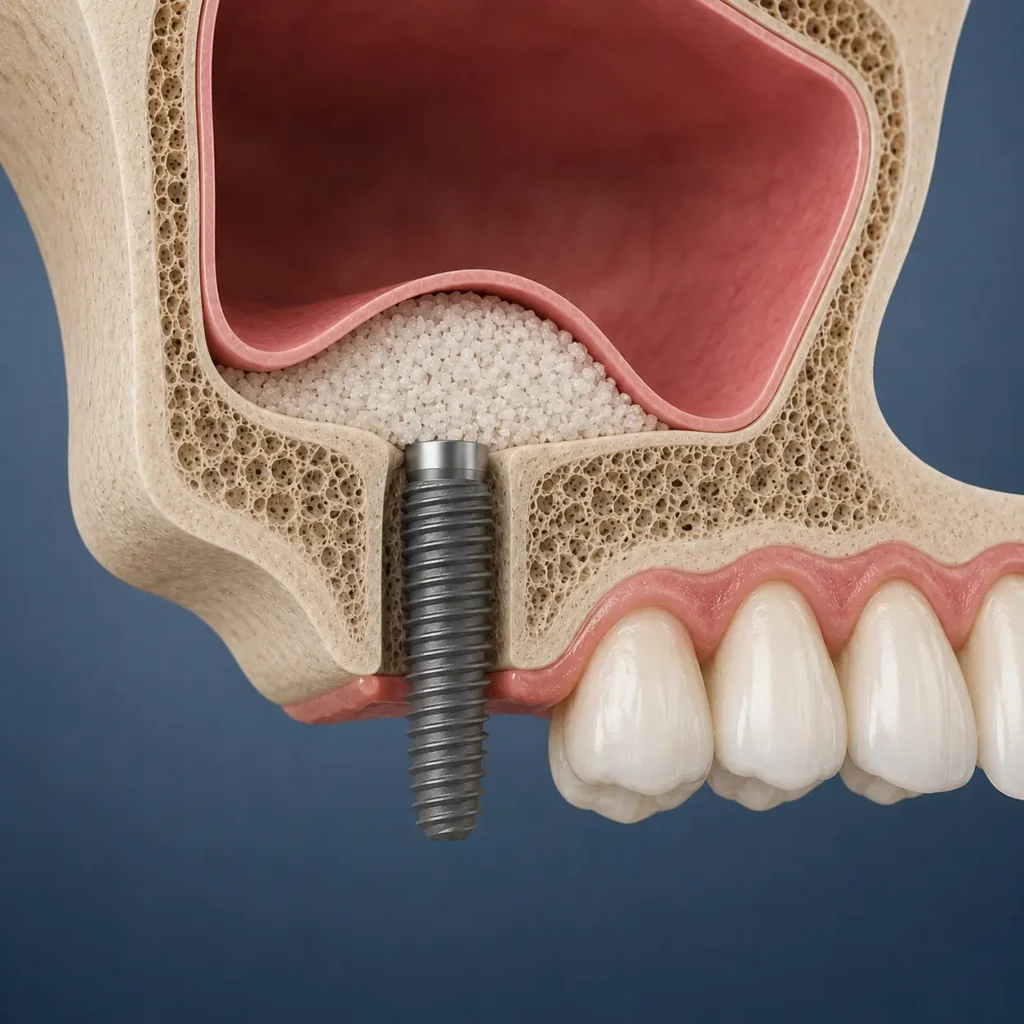
A sinus lift is a surgical procedure that gently raises the membrane lining the sinus floor and places bone graft material in the space created. As the graft integrates over the following months, it turns into solid bone — giving a dental implant the height and density it needs to anchor securely. Clinically, the procedure is known as a maxillary sinus augmentation or sinus floor elevation.
It is one of the most common preparatory procedures in implant dentistry, performed routinely in accredited clinics every day.
Why Would You Need a Sinus Lift Before Dental Implants?
Two things happen after you lose an upper back tooth, and together they reduce the bone available for an implant:
The jawbone shrinks. Once a tooth is gone, the bone that used to hold it is no longer stimulated by chewing, so it gradually resorbs. (This is the same process explained in our guide on how missing teeth cause bone loss.)
The sinus expands. The maxillary sinus slowly enlarges into the empty space above — a process called pneumatisation — pushing the sinus floor lower and leaving only a paper-thin shelf of bone.
A dental implant needs enough bone height and width to stay stable and to fuse with the bone (osseointegration). In the upper back jaw, that’s often around 10 mm of height. When tooth loss and sinus expansion leave less than that, a sinus lift restores the missing bone so implants become possible.
How Do You Know If You Need a Sinus Lift?
You can’t tell from the mirror — it’s decided from imaging. During planning, the dentist takes a 3D CBCT scan, which measures the exact bone height below your sinus and shows the shape of the sinus floor. (You can read more about this in our article on 3D dental tomography (CBCT).)
As a general guide:
- 10 mm or more of bone below the sinus — usually no lift needed.
- 5–8 mm — a crestal (closed) sinus lift is often enough, frequently with the implant placed at the same time.
- Less than 4–5 mm — a lateral window (open) sinus lift is usually required, and the implant may be placed later.
These thresholds are a rule of thumb; the final decision depends on your scan and the surgeon’s assessment.
Types of Sinus Lift: Closed vs Open
There are two main techniques, chosen according to how much bone you have left.
Crestal (closed / internal) sinus lift
Also called the osteotome or “indirect” technique, this is done through the implant site itself — no separate window is needed. The surgeon prepares the implant channel and gently taps the sinus floor upward, placing a small amount of graft. It suits moderate bone deficiency and usually allows the implant to go in during the same appointment.
Lateral window (open / external) sinus lift
For significant bone loss, the surgeon creates a small access window in the side wall of the sinus, carefully lifts the membrane, and packs a larger volume of graft beneath it. It adds more bone than the closed method and is the technique of choice when very little bone remains.
| Crestal (closed) | Lateral window (open) | |
| Best for | Mild–moderate bone loss (≈5–8 mm) | Significant bone loss (<4–5 mm) |
| Access | Through the implant site | Small window in the sinus wall |
| Bone gained | Modest | Greater |
| Implant timing | Often same day | Frequently placed after healing |
| Recovery | Very quick | Slightly longer |
Can the Implant Be Placed at the Same Time?
Sometimes — it depends on how much of your own bone remains. If there’s enough residual bone to hold the implant firmly on the day (generally around 4–5 mm or more), the graft and implant can be done together in a simultaneous procedure. If the bone is too thin to grip the implant, the sinus is grafted first and left to heal for about 4–6 months before the implant is placed in a staged approach. The staged route takes longer but is often the safer choice when bone is very limited.
How Is a Sinus Lift Performed? Step by Step
A lateral window sinus lift usually follows these stages:
- Consultation and 3D scan. The surgeon reviews your CBCT scan, confirms the bone height, and plans the technique and graft volume.
- Anaesthesia. The area is numbed with local anaesthesia. Sedation can be added for comfort if you’re anxious — you won’t feel pain during the procedure.
- Accessing the sinus. A small incision exposes the bone, and a tiny window is created in the sinus wall.
- Lifting the membrane. The delicate sinus membrane is carefully separated from the bone and raised, creating a protected space above the jaw.
- Placing the graft. Bone graft material is packed into the space. A protective membrane is often placed over the site.
- Closing. The gum is repositioned and sutured. If conditions allow, the implant may be placed in the same session.
The procedure itself typically takes around 60–90 minutes per side. Most patients say it feels comparable to having a tooth removed rather than to major surgery. Once healed, the implant stage follows the standard implant procedure.
What Bone Graft Materials Are Used?
Several graft materials are used, alone or in combination, and all work as a scaffold that your own bone gradually replaces:
- Autograft — your own bone, taken from elsewhere in the mouth.
- Allograft — processed human donor bone.
- Xenograft — treated animal-derived bone (bovine is common); well-documented and widely used.
- Alloplast — synthetic, biocompatible graft material.
The right choice depends on the size of the defect and the surgeon’s plan. You can read more about grafting in our guide to bone graft treatment for jawbone loss.
Recovery and Aftercare
Recovery from a sinus lift is generally straightforward. Expect some swelling and possibly mild bruising for 3–5 days, managed with prescribed medication. To protect the graft and the sinus membrane while they heal, follow these guidelines:
- Don’t blow your nose forcefully for the first 1–2 weeks; sneeze with your mouth open to release pressure.
- Avoid straws, smoking and heavy lifting, which create suction or pressure that can disturb the graft.
- Eat soft foods and chew on the opposite side.
- Sleep with your head slightly elevated for the first few nights.
- Take antibiotics and any decongestants exactly as prescribed, and keep the area clean as directed.
A note for dental tourists — flying after a sinus lift. Cabin pressure changes put stress on the healing sinus, so surgeons usually advise not flying immediately after the procedure. Build a short buffer into your travel plans and confirm your personal fit-to-fly window with the surgical team before booking return flights. Planning your trip around treatment is covered in our 5-day dental treatment itinerary for Istanbul.
Healing Timeline
For a staged case, the graft needs roughly 4–6 months to consolidate into bone strong enough to hold an implant, though this varies with graft type and individual healing. Once the implant is placed, it then goes through its own osseointegration and healing period before the final teeth are fitted. When the implant is placed at the same time as the lift, the overall timeline is shorter.
Risks and Possible Complications
A sinus lift is very safe in experienced hands, but as with any surgery there are risks to be aware of:
- Sinus membrane perforation — the most common event; small tears are usually repaired during the procedure without affecting the outcome.
- Infection or sinusitis — uncommon and typically manageable with medication.
- Graft not integrating — rare; the procedure may need to be repeated if it occurs.
- Swelling, bruising or minor bleeding — expected and short-lived.
Choosing an experienced oral surgeon, using 3D planning, and following aftercare instructions keep these risks low.
What Is the Success Rate?
Sinus augmentation is one of the most predictable procedures in implant dentistry. Implants placed in a properly grafted sinus show survival rates comparable to implants in natural bone — commonly reported above 95% when performed by an experienced surgeon.
Alternatives to a Sinus Lift
A sinus lift isn’t the only route when upper-jaw bone is limited. Depending on your case, alternatives include:
- Zygomatic implants — long implants anchored in the cheekbone that bypass the sinus entirely, used for severe bone loss. See when a zygomatic implant is needed.
- Short implants — where just enough bone exists to place a shorter fixture without grafting.
- Tilted implants / All-on-4 — angled placement that avoids the sinus in full-arch cases. See our guide to All-on-4 and All-on-6 methods.
Which option fits best depends on your scan — our article on choosing an implant for patients with bone deficiency explains this in more detail.
Sinus Lifting in Istanbul: What to Expect
Istanbul is one of the world’s leading destinations for implant dentistry, combining specialist oral surgeons, 3D-guided planning and prices well below those in the UK, Europe and the US. Ömer İstanbul is an ISO 9001:2015-certified clinic, named Turkey’s Best Cosmetic Dental Center, treating tens of thousands of international patients each year.
Because the healing graft is sensitive to air-pressure changes, your treatment coordinator will plan the timing of your visit and your return flight around the procedure. Before booking anywhere, confirm the surgeon’s registration, the graft brand used, and the written aftercare and warranty terms.
Frequently Asked Questions
Is a sinus lift painful?
No. It’s performed under local anaesthesia, so you don’t feel pain during the procedure. Afterwards, most people have mild swelling for a few days, comparable to a tooth extraction.
How long does a sinus lift take to heal?
When the implant is placed later, the graft usually needs about 4–6 months to become solid enough to hold an implant. When the implant is placed at the same time, the overall timeline is shorter.
Can I fly after a sinus lift?
Not immediately. Cabin pressure stresses the healing sinus, so surgeons advise waiting and confirming your personal fit-to-fly window before booking return travel.
Can the implant be placed at the same time as the sinus lift?
Yes, if enough of your own bone remains (generally around 4–5 mm or more) to hold the implant securely. If not, the graft heals first and the implant is placed later.
Is a sinus lift safe?
Yes. It’s a routine, well-established procedure with a success rate above 95% when performed by an experienced surgeon. The most common issue, a small membrane tear, is usually repaired during surgery.
Does a sinus lift cause sinusitis?
It’s uncommon. Sinusitis after the procedure is infrequent and usually resolves with medication when it does occur.
How much does a sinus lift cost in Turkey?
In 2026, a sinus lift in Turkey typically costs from around £250 per side for the closed technique and from around £700 per side for the open technique — well below UK prices.
Ready to Find Out If You Need a Sinus Lift?
If you’ve been told there isn’t enough bone for an upper implant, a sinus lift is the standard, reliable solution — and it makes implants possible where they otherwise wouldn’t be. To find out whether you need one, book a free online consultation and send us your X-ray or CBCT scan. Our implant team will review it and give you a personalised plan and quote.