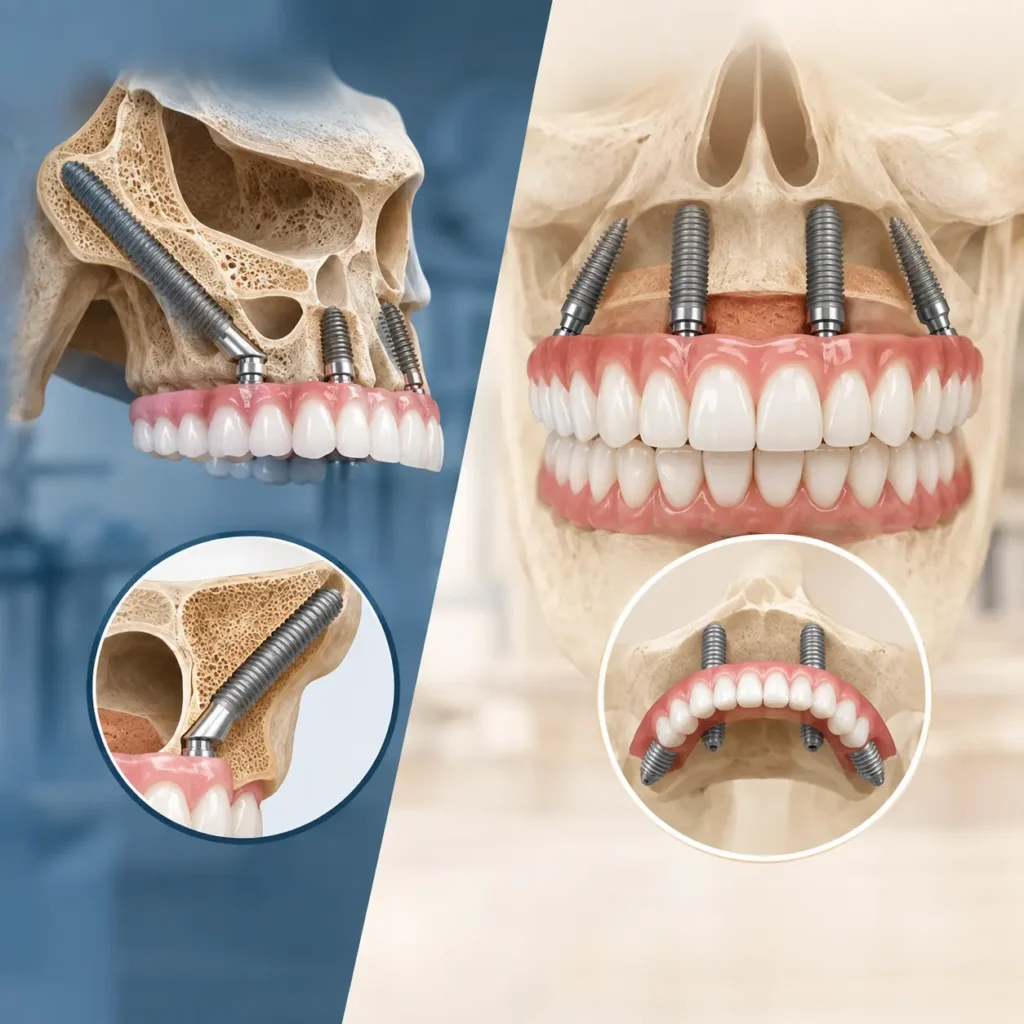
All-on-4 and zygomatic implants are not competitors; they are different solutions for different bone conditions. If you have enough bone in your upper jaw to support a fixed prosthesis, the right choice is usually All-on-4 — it is simpler and sufficient. If the bone has severely resorbed and classic implants or grafting are not feasible, zygomatic implants come into play; these implants anchor into your cheekbone (zygoma), not your jawbone. The decision is determined by the bone measurement on a CT scan (CBCT), not by guesswork.
Comparison table
| All-on-4 | Zygomatic Implant | |
| Typical candidate | Sufficient bone is present to support a fixed prosthesis | Severe (advanced) bone loss in the upper jaw |
| Number and location of implants | 4 implants, jawbone (2 straight front + 2 tilted back) | 1–2 (sometimes 4 = quad zygoma) long implants, cheekbone |
| Bone graft | Usually not required | Not required (preferred precisely to avoid grafting) |
| Applicable jaw | Upper and lower jaw | Upper jaw only |
| Surgical scope | Moderate | More advanced; requires oral and maxillofacial surgery expertise |
| Receiving fixed teeth | Temporary prosthesis on the same day in most cases | Temporary prosthesis on the same day in most cases |
| Anesthesia | Usually sedation | Sedation or general anesthesia |
Most people experiencing tooth loss encounter the same dilemma when they start researching online: “Is All-on-4 better, or zygomatic implants?” However, this is not the right question to ask. These two are not in a race; it is a matter of matching — what determines which one suits you is the condition of the bone in your mouth. Below, we frame this match clearly.
What is All-on-4?
All-on-4 is a treatment concept that restores a fully edentulous jaw to a fixed bridge using only four implants. Two implants are placed vertically in the anterior region of the jaw, while two implants are placed in the posterior region at an angle of 30–45 degrees. The purpose of this angled placement is to utilize the denser, higher-quality bone in the front of the jaw and bypass the lack of bone in the back — thus eliminating the need for bone grafting in most cases and allowing the patient to leave the clinic with temporary fixed teeth on the same day. The strongest scenario for All-on-4 is jaws where bone has diminished but is not completely depleted. The process begins with digital planning to calculate the implant angles down to the millimeter.
What is a zygomatic implant?
A zygomatic implant is significantly longer than a standard implant (typically 30–55 mm) and features a specialized design and angle. It takes its name from the region where it is placed: the zygoma, or cheekbone. When upper jawbone loss is severe, standard implants cannot gain support in the jaw; however, because the cheekbone is naturally much denser and sturdier, it acts as a strong anchor. This allows for fixed teeth without the need for additional surgeries like bone grafting or sinus lifts, which can take months. Zygomatic implants are often the only remaining fixed solution for patients who have been toothless for years and have been turned away with the answer, “Your bone is not suitable for implants.” You can also check out our detailed zygomatic implant content, where we explain what it is and who it is suitable for.
The fundamental difference: it’s not about which is “better,” but how much bone you have
The line dividing the two methods comes down to a single variable: the amount of usable bone remaining in your upper jaw, especially in the posterior region.
- If your bone is sufficient to safely support a fixed prosthesis, the complexity of a zygomatic implant is unnecessary; All-on-4 is the simpler and right choice.
- If the bone has severely resorbed and standard implants cannot hold, there is no foundation left for All-on-4 either; this is where zygomatic implants enter the picture.
Therefore, the only honest answer to the question “which one is better?” is “it depends on your bone.” A good clinic will not recommend heavier surgery when your bone is sufficient.
In which case All-on-4?
- Patients with complete or extensive tooth loss in the upper or lower jaw,
- Patients with sufficient anterior bone to support a fixed prosthesis,
- Patients who want to get rid of removable dentures and transition to fixed teeth,
- Patients looking for a fast, graft-free solution whenever possible.
In which case zygomatic implants?
- Patients with severe (advanced) bone loss in the upper jaw,
- Patients who have tried conventional implants before and had them fail,
- Patients who are not suitable for, or do not want, bone grafting or sinus lifts,
- Patients who have been toothless for years and told “you cannot get implants.”
Zygomatic implants are for the upper jaw only; since there is no zygoma bone in the lower jaw, this method is not applied there.
What determines the decision? CBCT and bone measurement
This decision is not made by guesswork in the clinic, but through millimeter-accurate measurement on a three-dimensional CT scan (CBCT). The surgeon measures the height and width of the bone in every potential implant site; if there is sufficient bone in the posterior upper jaw, All-on-4 is planned; if not, the zygomatic approach comes to the agenda. Biomechanical studies also support this planning by comparing how loads are distributed to the bone in tilted implant and zygomatic configurations. Thus, the entire path, including options like bone grafting and sinus lifts, becomes clear with a single CT scan.
Can both be used together?
Yes. In some advanced cases, especially where the entire upper jaw has resorbed, two zygomatic implants can be planned alongside two classic implants, or as four zygomatic implants (quad zygoma). In other words, these are not mutually exclusive options; they are solutions that can be combined according to your bone map. Which combination will be used is again determined during digital planning.
When will I get my fixed teeth?
The biggest advantage of both methods is this: in most cases, you leave the clinic on the same day with a temporary fixed prosthesis. The permanent zirconium prosthesis is made after healing is complete, usually within a few months. The difference is not in the treatment duration, but in the surgical scope.
What about safety and longevity?
When applied to the right patient with proper planning, both methods can be used problem-free for many years. However, to be honest: due to its proximity to the cheekbone and sinus cavity, zygomatic implants are a more advanced surgical procedure than All-on-4 and should be performed by an experienced oral and maxillofacial surgeon. For this reason, the question “who is performing it?” is just as important as “which method?” The experience of the surgical team is the main factor determining the longevity of the result.
Let’s measure your bone and see the right method together
The answer to whether All-on-4 or zygomatic implants are right for you is not with you, but in your CT scan. At Ömer İstanbul, you can clearly see which method suits you with a single CBCT scan and consultation.
Get a free treatment plan and discover your personalized options based on your bone condition.
Frequently Asked Questions
Are zygomatic implants or All-on-4 better?
One is not “better” than the other; they are different solutions for different bone conditions. If there is sufficient bone, All-on-4 is preferred; if there is severe bone loss, zygomatic implants are preferred.
Can zygomatic implants be placed in the lower jaw?
No. Because the zygoma (cheekbone) is located only in the upper jaw, this method is valid only for the upper jaw. All-on-4 can be applied to the lower jaw.
Do you get fixed teeth on the same day?
In most cases, yes; with both methods, a temporary fixed prosthesis can be applied on the same day. The permanent prosthesis is placed a few months later.
How is the decision made?
The height and width of the bone in the upper jaw are measured using three-dimensional tomography (CBCT); the decision is determined based on these measurements and clinical examination.